Master Your Violin Tuning: GDAE Notes Explained with a Free Tuner
Ever picked up a violin and wondered what notes it should be tuned to? For every aspiring violinist, understanding the standard tuning notes—G, D, A, and E—is the first, most crucial step toward making beautiful music. Knowing your violin tuning notes is the foundation upon which all your future playing will be built. So, what are the notes for tuning a violin?
This guide will demystify each note, explain its specific frequency, and reveal why this particular tuning is so fundamental to the violin's sound and history. By the end, you'll have the confidence to tune your instrument accurately and efficiently. When you're ready to put this knowledge into practice, our free online violin tuner can provide instant, precise feedback right from your browser. Get ready to tune with confidence!
Understanding the Four Essential Violin Tuning Notes
The violin has four strings, and when you pluck or bow them without pressing any fingers down (an "open" string), they produce four distinct pitches. These are universally tuned to G, D, A, and E, starting from the thickest, lowest-sounding string to the thinnest, highest-sounding one. Let's explore each one.
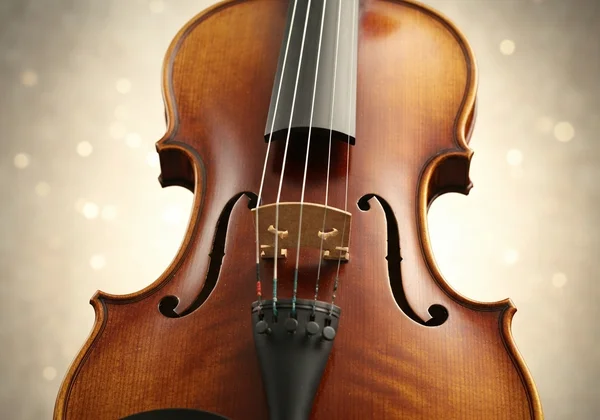
G3: The Deepest String's Foundation
The G string is the lowest and thickest string on your violin. Its official name is G3, which places it just below middle C on a piano. This note provides the deep, resonant base for chords and gives the violin its rich, full-bodied voice in its lower register. When tuning, listen for a warm, sonorous tone. Achieving the correct pitch for G3 is essential, as it acts as the anchor for the other strings. If this note is off, the entire instrument will sound out of tune, no matter how perfectly you adjust the others.
D4: The Resonant Middle Ground
Moving up from the G string, the next one is the D4 string. This note sits in the middle register of the violin, offering a powerful and versatile voice that connects the deep G string to the brighter upper strings. D4 is a critical note in many beginner pieces and scales, making its accuracy vital for early learning. It should sound clear and steady, providing a smooth transition as you play melodies that move across the strings. A well-tuned D string helps ensure that the intervals between notes sound correct and pleasing to the ear.
A4: The Universal Reference Pitch
The A4 string is arguably the most important one for tuning. This is the note that orchestras traditionally use as a reference point to tune all their instruments together. Its frequency is standardized at 440 Hertz (Hz), a pitch often referred to as A440. When you use an electronic or an online violin tuner, the A string is usually the first one you'll tune. Its bright, clear tone cuts through easily, making it an excellent guidepost. Once your A string is perfectly set, you have a reliable reference on your own instrument to help tune the remaining strings. You can test its accuracy right now with our online violin tuner.
E5: The Brightest and Highest Voice
Finally, the thinnest and highest-pitched string is the E5 string. This is the violin's "singing" voice, responsible for soaring melodies and brilliant, sparkling passages. Because it's under the most tension, the E string is often the most challenging to tune, especially for beginners using pegs. This is why most violins are equipped with a fine tuner specifically for the E string. Achieving a perfect E5 pitch is what gives the violin its characteristic brilliance and allows it to stand out in an ensemble. Our accurate tuning tool helps you zero in on this high note without the risk of breaking the string.
Why GDAE? The Standard Violin Tuning Explained
Have you ever wondered why violins are tuned specifically to G, D, A, and E? This isn't an arbitrary choice; it's based on centuries of musical tradition and acoustic logic. The standard violin tuning is designed for maximum resonance, comfortable fingering, and harmonic richness.
The Logic Behind Standard Intervals (Perfect Fifths)
The relationship between each adjacent string on the violin is an interval known as a perfect fifth. This means that if you go up five notes in a major scale from G, you land on D. Go up five from D, and you get A. Five notes up from A brings you to E. This tuning system is incredibly efficient for a few reasons. First, it gives the violinist a wide range of notes—from G3 to the very high notes on the E string—within a compact four-string setup. Second, the perfect fifth interval is a very pure and resonant sound in Western music, allowing the instrument to vibrate sympathetically and produce a rich, ringing tone when played. This harmonic relationship makes playing chords and scales feel logical and sound beautiful.

A Brief History of Violin Tuning Standards
The GDAE tuning has been the standard for violins since the instrument's emergence in 16th-century Italy. Early violin makers like Andrea Amati and Gasparo da Salò established this tuning, and it was solidified by the masterworks of composers like Claudio Monteverdi and Antonio Vivaldi. While the exact reference pitch for A4 has fluctuated over the centuries (it was often lower than today's A440 standard), the relationship of perfect fifths between the strings has remained constant. This enduring standard is a testament to its acoustic perfection and practical playability, a core part of the history of violin tuning.
Improve Your Violin Tuning Accuracy: Visualizing and Hearing Notes
Knowing the names of the notes is one thing; recognizing them by sight on sheet music and by ear is the next step. A reliable violin tuner is your best friend here, as it provides instant visual and auditory confirmation that you've hit the right pitch. Using a tool like our browser-based violin tuner makes this process simple and effective.
Mapping GDAE on the Musical Staff (With Diagrams)
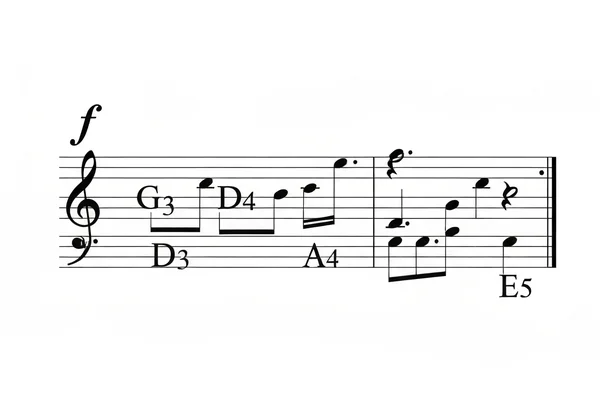
For those learning to read music, it’s vital to know where the open strings G, D, A, and E are located on the musical staff. The violin uses the treble clef.
-
G3 is the note on the second line from the bottom of the staff.
-
D4 is the note in the space just below the bottom line of the staff.
-
A4 is the note in the second space from the bottom.
-
E5 is the note in the top space of the staff. Recognizing these violin notes on staff helps connect the theory of tuning with the practice of reading and playing music.
Exact Frequencies: The Science of Perfect Pitch (Hz)
Every musical note corresponds to a specific sound wave frequency, measured in Hertz (Hz). For standard tuning based on A=440 Hz, the frequencies are:
-
G3: 196.00 Hz
-
D4: 293.66 Hz
-
A4: 440.00 Hz
-
E5: 659.25 Hz You don't need to memorize these numbers, but it helps to understand that tuning is a science. A digital violin tuner works by measuring the frequency of your string and telling you if it’s sharp (too high) or flat (too low). This is how our precise violin tuner provides such accurate, real-time feedback to help you match these exact violin string frequencies.
Listen and Learn: Audio Examples for Each String
The ultimate goal is to train your ear to recognize when a note is in tune. The best way to do this is by repeatedly listening to the correct pitches. Many online resources provide violin tuning audio files for G, D, A, and E. Play the reference note, then try to match it by adjusting your violin's pegs and fine tuners. As you do this regularly, your sense of pitch will improve dramatically, and you'll eventually be able to tune more quickly and with less reliance on a visual display.
Ready to Tune? Your Path to Perfect Pitch Begins Now
Understanding the four essential violin tuning notes—G3, D4, A4, and E5—is the first major milestone on your musical journey. It transforms tuning from a frustrating chore into an empowering act of preparing your instrument to create beautiful sound. Knowing why they are tuned in perfect fifths and what they look and sound like gives you complete control over your violin's voice.
Now that you're armed with this foundational knowledge, it's time to put it into practice. Don't let an out-of-tune instrument hold you back. Don't wait any longer to experience perfect pitch. Head to our homepage and try our free violin tuner to get your instrument sounding its best, instantly!
Frequently Asked Questions About Violin Tuning Notes
What are the notes for tuning a violin (G, D, A, E)?
The four open strings of a violin are tuned to the notes G, D, A, and E. The order starts with G as the lowest, thickest string, and moves progressively higher to E, the thinnest string. This GDAE sequence is the universal standard for violins worldwide.
Is GDAE the only way to tune a violin?
While GDAE is the standard tuning for classical, jazz, and most other genres, alternative tunings (called scordatura) do exist. Composers sometimes require players to retune a string to create special effects or make certain passages easier to play. However, for 99% of your playing, especially as a learner, you should stick strictly to the standard GDAE tuning.
What does A440 mean in violin tuning?
A440 refers to the tuning standard where the note A above middle C (A4) is set to a frequency of 440 Hz. This serves as the reference pitch for orchestras and musicians globally to ensure everyone is in tune with each other. When you tune your A string, this is the target pitch you are aiming for, a process made easy with an online violin tuner.
How often should I check my violin's tuning notes?
You should check your violin's tuning every single time you play. Violins are sensitive to changes in temperature and humidity, which can cause the wooden pegs and the strings themselves to expand or contract, altering their pitch. Making tuning the first step of every practice session is a crucial habit for every violinist.