The Expert Violin Tuner's Guide: Achieving Perfect Pitch by Ear
The sound of a professional violinist tuning their instrument on stage is a familiar prelude to a breathtaking performance. With a few deft turns of a peg, they achieve perfect intonation, seemingly by magic. While a digital violin tuner has made this process accessible to everyone, the art of aural tuning remains a hallmark of true mastery. But how do they achieve such flawless intonation without constantly reaching for a device?
Professionals master this skill through a blend of a highly developed ear, a deep grasp of the instrument's physics, and tried-and-true techniques. This guide will demystify these professional methods. While developing these skills takes practice, having a reliable benchmark is crucial. You can always verify your pitch against our precise online violin tuner as you train your ear, ensuring you're building a solid foundation for musical excellence.
Tune Violin by Ear: Developing Your Internal Pitch Sense
At the heart of professional tuning is the ability to hear and identify correct intervals. This isn't about having "perfect pitch" from birth; it's a trainable skill known as developing your relative pitch. Professionals listen not just to individual notes but to the relationships between the notes. They are listening for the pure, resonant sound that occurs when two strings are in perfect harmony.
How Relative Tuning Improves Your Violin Tuner Skills
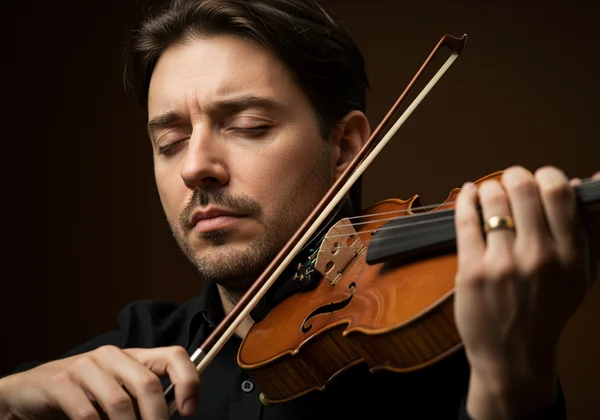
Relative tuning is the process of tuning the violin's strings to each other, rather than to an external violin tuner for every single note. The standard violin is tuned in perfect fifths: G, D, A, and E. Once a single reference note is established (usually the A string), a professional tunes the other strings based on that initial pitch.
This approach is vital for a few key reasons. It trains the musician's ear to recognize intervals, which is fundamental for playing in tune. It is also faster and more practical in a performance or rehearsal setting. Most importantly, it connects the player to their instrument on a deeper level, transforming tuning from a mechanical chore into a musical act.
Practical Exercises to Cultivate Advanced Aural Skills
Developing your ear is a journey, not a destination. Consistency is key. Start by integrating these simple exercises into your daily practice routine:
- Interval Training: Use a piano or a reliable digital tool to play a perfect fifth. Sing the interval, then try to replicate it by humming or on your violin.
- Beat Elimination: When two notes are slightly out of tune, they create a wavering sound or "beat." As you tune one string against another (like the D against the A), listen for this beat. Adjust the peg slowly until the wavering disappears and you hear a single, pure, unified sound.
- Check Your Work: After tuning by ear, use a high-precision tool to check your accuracy. Our free browser tuner provides instant visual feedback, helping you correlate what you hear with what is technically correct.
Advanced Violin Tuner Techniques: Precision with Harmonics
For even greater accuracy, many professionals use natural harmonics. Harmonics are the pure, bell-like tones produced by lightly touching the string at specific points (nodes) rather than pressing it down to the fingerboard. This technique allows for an exceptionally precise comparison of pitches between strings.

Identifying Natural Harmonics on Your Violin
The easiest harmonic to find is at the midpoint of the string. By lightly placing your finger on the string directly above the octave (halfway between the nut and the bridge) and drawing the bow, you'll produce a note that is one octave higher than the open string.
Another crucial set of harmonics for tuning is found one-third of the way up the string from the bridge. This harmonic produces a note that is an octave and a perfect fifth above the open string. It is this specific harmonic that makes tuning pairs of strings against each other so effective.
Step-by-Step Guide: Tuning GDAE Strings with Harmonics
Once you have a reference pitch for your A string, you can tune the rest of the violin with remarkable precision using this method:
- Tune the D String to the A String: Play the harmonic found one-third of the way up the D string. This note should be a perfect unison with your open A string. Adjust the D string's peg until the two pitches ring as one, with no beats.
- Tune the G String to the D String: Next, play the harmonic found one-third of the way up the G string. This pitch should match your open D string perfectly. Adjust the G string's peg until they align.
- Tune the E String to the A String: This is slightly different. Play the harmonic at the midpoint of the A string (producing an A one octave higher). This should match the harmonic found one-third of the way up the E string. Alternatively, and more commonly, players will play the A string open and tune the E string a perfect fifth above it using the beat elimination method described earlier.
This technique requires a sensitive touch and a focused ear, but it is one of the most accurate ways to start tuning now without relying on an electronic violin tuner.
The A440 Tuning Fork Standard: Your Starting Pitch
Even the most skilled ear needs a starting point. In an orchestral setting, that starting point is almost universally "A440." This is the concert pitch standard where the A above middle C vibrates at a frequency of 440 Hertz (Hz).
Understanding A440: The Universal Pitch Standard
The A440 standard ensures that all instruments in an orchestra, choir, or ensemble are calibrated to the same reference, allowing them to play in harmony. Before an orchestra plays, the principal oboist sounds an A440, and the rest of the musicians tune their instruments to that single note. This tradition establishes a consistent tonal foundation for the entire group. When practicing alone, a musician needs a reliable source for this critical reference pitch.
Utilizing Tuning Forks and Orchestral References for Initial Pitch
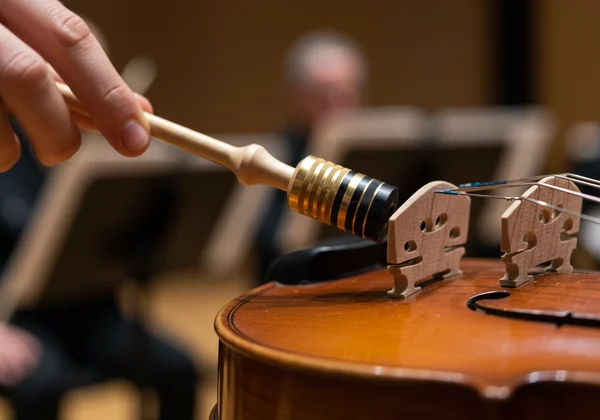
The classic tool for getting a reference A is the tuning fork. When struck, an A440 tuning fork produces a pure tone at the correct frequency. The violinist can hold the vibrating fork to the bridge of the violin to hear the pitch resonate through the instrument, then adjust their A string to match.
In the absence of a tuning fork or an oboe, a modern musician has excellent alternatives. You can use the reference tone feature available on many digital violin tuner models or simply use our precise violin tuner to sound a perfect A440 directly from your computer or phone's speaker. Once your A string is set, you can apply the relative and harmonic tuning techniques to the other strings.
Beyond the Basics: Advanced Considerations for Professional Tuning
Tuning for a professional isn't just about hitting the right notes; it's about understanding the nuances of the instrument and its environment.

Why Many Professionals Opt Out of Using Fine Tuners
You may have noticed that many world-class violinists have only one fine tuner—on the E string—or sometimes none at all. Why do professional violinists not use fine tuners? The primary reasons are related to sound and mechanics. Each piece of hardware added to the tailpiece can subtly dampen the instrument's resonance and change its tonal quality. Professionals prefer the purest possible sound from their violins. Furthermore, they rely on high-quality, perfectly fitted pegs that allow for smooth and precise adjustments, making fine tuners for the G, D, and A strings redundant.
The Environmental Impact: Temperature and Humidity on Pitch Stability
A violin is a living object made of wood, which expands and contracts with changes in temperature and humidity. A professional musician is keenly aware of this. They anticipate how their instrument will react when moving from a cold room to a warm stage. Pegs can slip in dry conditions or stick when it's humid. A professional learns to make micro-adjustments constantly, even during a performance, to maintain perfect intonation as the instrument acclimates.
Embracing the Art of Aural Tuning for Musical Mastery
Learning how professionals tune a violin is to embark on a journey toward true musical self-reliance. It's about training your ear to be the ultimate arbiter of pitch. By mastering relative tuning, leveraging the precision of harmonics, and understanding the importance of a standard reference pitch, you elevate your musicianship.
This path requires patience and practice. As you develop these advanced skills, remember that a reliable digital violin tuner is your best friend. Use it to set your reference pitch, check your work, and build the confidence you need to eventually tune with nothing but your ear. Ready to take the next step? Visit ViolinTuner.org to access your essential practice partner.
Frequently Asked Questions About Professional Violin Tuning
How do professionals tune a violin without a digital violin tuner?
Professionals develop a skill called "relative pitch." They start with one reference note, typically A=440Hz, obtained from a tuning fork or orchestra's oboe. They then tune the other strings in perfect fifths (G-D, D-A, A-E) by listening for the pure, beatless interval between strings, often using harmonics for enhanced precision.
Why do professional violinists often avoid using fine tuners on all strings?
Many professionals avoid using multiple fine tuners because the extra hardware on the tailpiece can slightly dampen the violin's resonance and alter its tone. They rely on well-fitted friction pegs which, with practice, offer sufficient control for precise adjustments on the G, D, and A strings. The high tension of the steel E string, however, typically necessitates one fine tuner.
What is the significance of A440 in professional orchestral tuning?
A440 (the note A vibrating at 440 Hz) is the international concert pitch standard. It provides a universal reference point that ensures all instruments in an ensemble are tuned consistently with each other. This uniformity is essential for creating a cohesive and harmonious sound in an orchestra or any musical group.
Can a beginner realistically learn to tune their violin by ear like a professional?
Absolutely. While it takes time and dedicated practice, any beginner can start training their ear. The key is to start simple: learn to hear the "beats" between out-of-tune strings and work on eliminating them. Using a reliable free online violin tuner to check your work is a crucial part of the learning process, helping you connect what you hear to what is correct.
How do external factors like temperature and humidity influence professional tuning practices?
Wood is sensitive to atmospheric changes. High humidity can cause it to swell, making pegs stick, while low humidity can cause it to shrink, making pegs slip. Professionals are aware of this and will often arrive early to let their instrument acclimate to a new environment. They make constant, subtle adjustments to counteract these effects and maintain stable pitch.