Understanding Violin Tuning Physics: A Guide for Violinists
The frustration of a perfectly tuned violin going out of tune hours—or even minutes—later has puzzled musicians for centuries. While we instinctively know that turning the pegs changes the pitch, the science behind how string tension, vibration, and environmental factors work together is often misunderstood. Why does my violin refuse to stay in tune?
For professional violinists, educators, and curious amateurs alike, once you understand these principles, you'll unlock the secret to making your violin sing exactly how you want it to. Knowing the "why" behind tuning instability empowers you to diagnose problems, make precise adjustments, and ultimately achieve a more stable and beautiful sound.
Let's explore the science behind violin tuning in simple terms. We will explore how strings create sound, the impact of tension, and how your environment constantly affects your instrument. By the end, you'll be better equipped to keep your violin in perfect pitch. And when you're ready to put theory into practice, you can try our free tool to check your work.
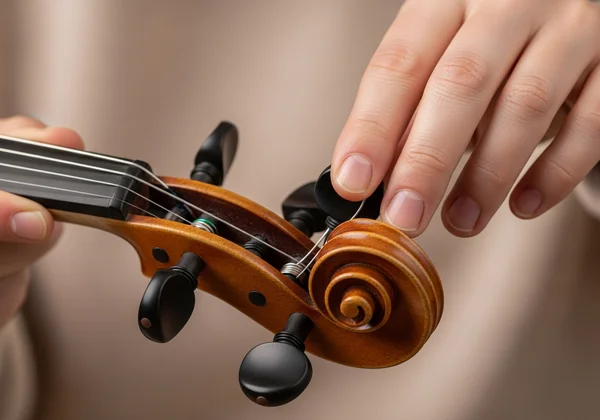
How Violin Strings Produce Sound and Pitch: The Science Behind Violin Tuning
At its core, a violin is a system designed to create and amplify vibrations. When you draw your bow across a string or pluck it, you transfer energy that causes the string to vibrate. This vibration creates all the sound your violin makes. The pitch—how high or low a note sounds—depends on how fast the string vibrates. We measure this speed as frequency.
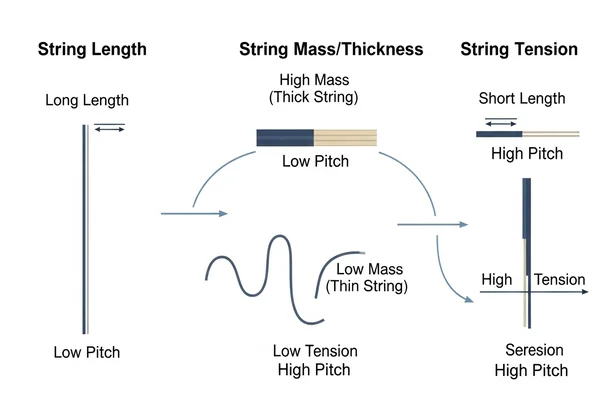
But what controls this frequency? It's not random. The pitch of each string (G, D, A, E) is a direct result of its physical properties. Three key factors work together: the string's length, its mass (or thickness), and the tension applied to it. By adjusting just one of these—tension—you can master the art of tuning.
The Relationship Between String Length, Tension, and Pitch
Think of a violin string as a simple physics experiment. The pitch you hear is governed by a clear, predictable relationship between three variables:
-
Length: The vibrating length of the string runs from the nut (at the top of the fingerboard) to the bridge. When you press a finger down on the fingerboard, you shorten this length, and the pitch goes up. This is the fundamental principle of playing different notes.
-
Mass (Thickness/Density): Thicker, heavier strings vibrate more slowly, producing a lower pitch. This is why the G string is the thickest and has the lowest note, while the E string is the thinnest and has the highest.
-
Tension: This is the variable you control during tuning. Increasing the tension by turning the pegs or fine tuners makes the string tighter. A tighter string vibrates faster, resulting in a higher pitch. Conversely, loosening the string decreases tension, lowers the vibration frequency, and produces a lower pitch. Understanding this direct link is the first step to confident tuning.
Harmonics and Overtones: The Hidden Complexity of Violin Tone
When a violin string vibrates, it produces multiple frequencies at once. First, it vibrates along its entire length, creating the main note you hear—the fundamental. At the same time, it also vibrates in smaller sections: halves, thirds, fourths, and more. These smaller vibrations create quieter, higher-pitched notes called overtones or harmonics.
These overtones are what give the violin its rich, complex, and unique voice. A pure sine wave from an electronic generator might have the same fundamental pitch (like A at 440 Hz), but it sounds sterile and flat because it lacks overtones. The specific blend and volume of these harmonics are what allow us to distinguish a violin from a flute or a piano playing the same note.
Proper tuning ensures that the fundamental frequency is correct, which in turn aligns all of the string's natural overtones. This creates a resonant, full-bodied tone that is pleasing to the ear. An out-of-tune string has a misaligned harmonic series, often sounding dull, dissonant, or "muddy."
String Tension Mathematics for Violin Tuning: What Every Player Should Know
While you don't need to be a mathematician to tune a violin, understanding the forces at play can help you appreciate why precision matters. The tension on each string isn't arbitrary; it's a specific force required to make the string vibrate at its target frequency. The cumulative tension from all four strings places significant pressure on the violin's body, particularly the bridge and top plate.
This is why small, careful adjustments are crucial. Abruptly tightening a string can put sudden stress on the instrument, and chronically incorrect tension can affect its long-term structural health. When you use an accurate online violin tuner, you are applying these physical principles to achieve the correct tension for each string, ensuring both musical accuracy and instrument safety.
Calculating Tension Across the Four Violin Strings
The exact tension of a violin string can be calculated with a physics formula that relates frequency, string length, and linear density (mass per unit of length). For a standard violin tuned to A=440 Hz, the approximate tensions are:
- G String: Around 12-13 pounds (5.4-5.9 kg)
- D String: Around 10-11 pounds (4.5-5.0 kg)
- A String: Around 12-13 pounds (5.4-5.9 kg)
- E String: Around 16-18 pounds (7.3-8.2 kg)
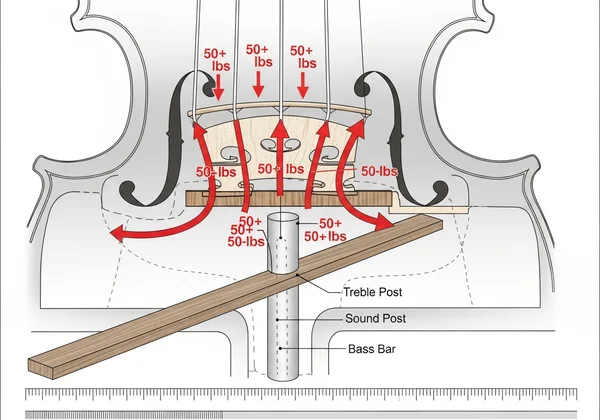
Notice the E string has the highest tension, despite being the thinnest. This is because it needs to vibrate at a much higher frequency (659.3 Hz) than the others. In total, the four strings exert a combined pressure of over 50 pounds (about 23 kg) on the bridge and top of the violin. This is a constant, significant force that your instrument is built to withstand.
Why Proper String Tension Matters for Instrument Health
Proper string tension matters for more than just playing in tune. It's crucial for your violin's health and longevity. With the right tension, the bridge stays securely in place. It also supports internal components like the sound post and bass bar. Additionally, it helps maintain the correct neck angle and fingerboard alignment.
- Bridge Position: The correct tension holds the bridge firmly in place through downward pressure. If tensions are unbalanced or too low, the bridge can start to lean or even fall over, which can damage the delicate top of the violin.
- Sound Post and Bass Bar: Inside your violin, the sound post and bass bar distribute the vibrations and support the structure against the string tension. Incorrect tension can lead to suboptimal sound transfer and, in extreme cases, put uneven stress on these critical internal components.
- Neck and Fingerboard: Consistent and proper tension helps maintain the correct neck angle and fingerboard alignment. Over-tensioning strings can, over a long period, contribute to the neck warping.
Using a reliable tuner ensures you aren't just guessing. Achieving the precise pitch for G, D, A, and E means you are also applying the correct, balanced force that your instrument was designed to handle. A good violin tuner is an essential tool for this job.
Environmental Factors and Their Impact on Violin Tuning Stability
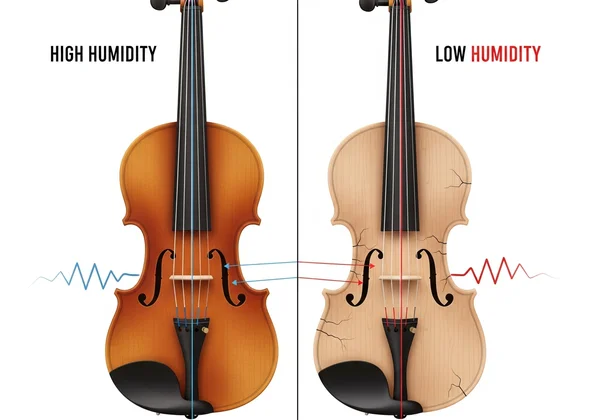
Have you ever tuned your violin perfectly indoors, only to find it's completely out of tune after stepping outside? You're not alone. Violins are made primarily of wood, a natural material that is highly sensitive to its environment. Changes in humidity and temperature cause the wood to expand or contract, directly affecting string tension and tuning stability.
Understanding these environmental factors is crucial for any violinist. It helps you anticipate tuning changes, protect your instrument from damage, and feel less frustrated when your pitch drifts. A quick check with a professional tuner before you play can save you from starting on a sour note.
How Humidity Affects Wooden Instruments
Wood is hygroscopic, meaning it absorbs and releases moisture from the air.
- High Humidity: In a humid environment, the wood of your violin will absorb moisture and swell. This expansion can cause several issues. The pegs may swell and become stuck in the pegbox, making them difficult to turn. The body of the violin expanding can slightly alter the string height and tension, causing the pitch to go flat.
- Low Humidity: In a dry environment, the wood releases moisture and shrinks. This is often more dangerous for the instrument. Pegs can become loose and slip, making it impossible to hold a pitch. More seriously, the wood contracting can lead to cracks, especially in the top plate. The pitch will often go sharp as the instrument's geometry shrinks.
Ideally, a violin should be kept in an environment with 40-60% relative humidity. Using a case hygrometer and a humidifier (or de-humidifier) is a wise investment for protecting your instrument.
Temperature Changes and Pitch: What Every Violinist Should Know
Just like humidity, temperature also plays a significant role in your violin's tuning. The strings themselves react to temperature changes.
- Rising Temperature: When it gets warmer, the metal or synthetic core of the strings will expand slightly. This increase in length reduces their tension, causing the pitch to drop or go flat. You'll often notice this if you move from a cool, air-conditioned room to a warm stage under hot lights.
- Falling Temperature: When it gets colder, the strings will contract. This shortening increases their tension, causing the pitch to rise or go sharp.
These changes are why orchestral musicians frequently re-tune between pieces during a concert. The heat from stage lights and the presence of an audience can noticeably alter the ambient temperature, requiring constant small adjustments to maintain perfect intonation. Knowing this helps you prepare for performances and practice sessions in different environments.
Mastering the Physics of Perfect Pitch
Understanding the physics behind violin tuning transforms it from a frustrating chore into a predictable science. We've seen that pitch is a direct result of string tension, which is your primary tool for adjustment. The complex overtones that create your violin's beautiful voice are all aligned when the fundamental note is accurate.
More importantly, we've learned that your instrument is a dynamic object. It responds to the math of string tension and the science of its environment. The constant pressure on the bridge, the subtle swelling of wood in high humidity, and the contraction of strings in the cold all conspire to pull your violin out of tune.
With these concepts under your belt, you'll approach your violin not just as a musician, but as someone who truly understands how to care for their instrument. You can now diagnose why your pegs are slipping, anticipate why your pitch is flat on a hot day, and appreciate the importance of precise adjustments.
The final step is translating this knowledge into action. The best way to apply these principles is with a reliable and accurate tuner. Whether you are a beginner learning the ropes or a professional needing a quick check, our free online violin tuner is designed for precision and ease. Put the physics to the test and tune your violin with confidence.
Frequently Asked Questions About Violin Tuning
How does temperature affect violin tuning stability?
Temperature directly impacts the metal or synthetic material of your violin strings. When the temperature rises, the strings expand slightly, which lowers their tension and causes the pitch to go flat. Conversely, when it gets colder, the strings contract, increasing tension and making the pitch go sharp. This is why you often need to re-tune when moving between environments with different temperatures.
Why do violin strings go out of tune so quickly?
Several factors contribute to this. The primary reason is the nature of wood; changes in humidity and temperature cause the violin's body and pegs to expand or contract, altering string tension. Additionally, new strings stretch and need time to settle. Finally, even the act of playing causes vibrations and slight shifts that can make the pitch drift. Regular tuning is simply a necessary part of playing the violin.
What causes the difference in pitch between violin strings?
The pitch of each string (G, D, A, E) is determined by its physical properties. Specifically, it's a combination of its mass (thickness), its vibrating length (from nut to bridge), and the tension applied to it. The G string is the thickest and has the lowest pitch, while the E string is the thinnest and is under high tension to produce the highest pitch.
How does string tension affect violin tone quality?
Proper string tension is crucial for good tone. When a string is tuned to its correct pitch, its fundamental frequency and its series of overtones are perfectly aligned. This creates a resonant, full, and pleasing sound. If the tension is too low or too high, the overtones become misaligned, resulting in a tone that can sound dull, thin, or dissonant. For an easy way to achieve the right tension, you can use a reliable tuner.
Why do professional violinists tune differently than beginners?
While both aim for the same result (perfect GDAE tuning), their methods may differ. Beginners often rely heavily on the four fine tuners on the tailpiece for small, safe adjustments. Professionals are very comfortable using the friction pegs in the pegbox for large and rapid pitch changes. They have a highly developed ear and muscle memory, allowing them to make swift, precise adjustments with the pegs that a beginner might find difficult or risky.