Why Professionals Avoid Fine Tuners: Advanced Violin Tuning
Ever noticed concert violinists rarely touch those tiny screws? While fine tuners help beginners, professionals embrace peg adjustments for a richer, more authentic sound. Let’s uncover why seasoned violinists favor pegs—and how our free precision tuner can help you master this essential skill.
Understanding professional techniques allows you to:
- Achieve purer resonance
- Reduce unwanted metallic tones
- Gain precise string tension control
At our online tuning platform, we support all skill levels with free tools and expert guidance. By adopting the methods in this guide, you can unlock a new dimension in your instrument's voice.
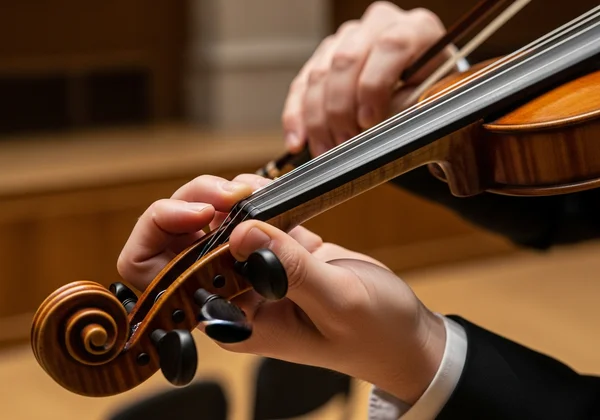
The Physics of Sound: Why Pros Prefer Peg Tuning
Fine tuners simplify micro-adjustments for beginners. However, professionals avoid them due to significant acoustic trade-offs. The preference for pegs is deeply rooted in the physics of how a violin produces sound.
Fine Tuners vs. Pegs: Tradeoffs in Precision and Resonance
-
Mass & Damping Effect Fine tuners add extra weight directly to the tailpiece. This seemingly small mass dampens the string's vibrations before they fully transfer to the violin's body, reducing natural sustain and warmth.
-
String Length Alteration The screw mechanism of a fine tuner shortens the "afterlength"—the portion of the string between the bridge and tailpiece. This subtle change impacts the string's overtone series, which are the layered, secondary tones that give a violin its complex and beautiful voice.
-
Tension Stability Issues Metal fine tuners expand and contract with temperature changes at a different rate than the violin's wooden body. This can cause instability, requiring frequent retuning during a performance, especially under shifting stage lights. Wooden pegs, when properly fitted, move with the instrument.
Professional violinists prioritize “open string purity,” allowing the violin to resonate as freely as possible without restrictive hardware. This tradition dates back centuries, long before fine tuners were invented, aligning with Baroque-era practices focused on maximizing the instrument's natural acoustic properties.
Step-by-Step Peg Tuning Techniques for Stability
Mastering peg adjustments demands a combination of ear training and tactile sensitivity. As you refine your peg technique, you'll gain an intuitive connection with your instrument. Follow this pro-level workflow for consistent results.
Calibrating Your Ear to A440 Standard
- Reference Pitch Source Play a calibrated A440 note from a reliable source to establish your reference. This trains your pitch memory and is the foundation for accurate tuning.
- Interval Matching After tuning the A string, tune the adjacent D and G strings using perfect fifths. Listen for "beats"—the slight pulsing sound caused by frequency mismatches. As you get closer to the correct pitch, the beats will slow down and eventually disappear.
- Cross-Check with Harmonics For a final check, gently touch your finger at the string’s midpoint to play a harmonic. Compare its pitch to the next open string; they should be perfectly in tune.
Preventing Peg Slippage: Lubrication and Positioning Tips
Peg tuning’s biggest frustration—sudden slipping or sticking—is almost always preventable with proper maintenance.
-
Chalk vs. Peg Compound: Use a specialized peg compound sparingly to provide the right balance of grip and smoothness. Too much creates jerky, imprecise movement.
-
Push-Spin Motion: As you turn a peg, apply gentle inward pressure. This "push-and-spin" motion engages the friction needed to hold the peg securely in the pegbox.
-
Temperature Awareness: Wood contracts in cold, dry environments, which can cause pegs to loosen. Always check your tuning after moving between different climates.
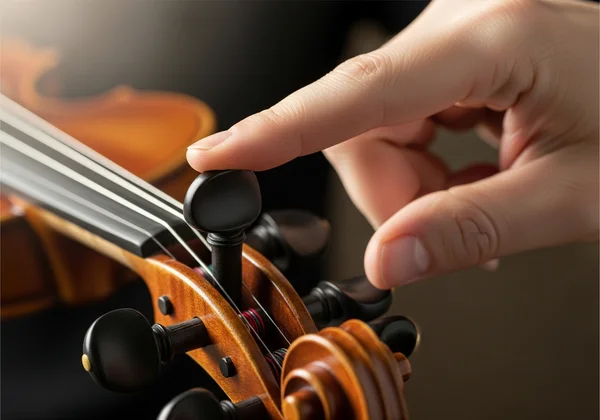
After adjusting pegs, verify your tuning for safety. Tools like our instant pitch feedback tool provide immediate confirmation that your strings are at the correct tension.
Common Peg Tuning Mistakes to Avoid
Transitioning to pegs can be challenging, but avoiding these common pitfalls will speed up your progress.
- Over-tightening the Strings: New users often turn the peg too far, too fast. This can snap a string or, in extreme cases, damage the pegbox. Always turn slowly and listen carefully.
- Forgetting the Inward Push: Simply turning the peg without pushing it in slightly is a common error. The peg won't "lock" into place and will likely slip as soon as you start playing.
- Winding Strings Improperly: Strings should be wound neatly from the inside of the pegbox toward the peg head. Crisscrossed windings create uneven tension and are a primary cause of slippage.
Practical Tips for Transitioning from Fine Tuners
Ready to make the switch? This doesn't have to be an intimidating leap. A gradual approach builds confidence and skill. This may feel tricky at first, but your persistence will pay off with brighter, clearer notes.
A Violinist's 30-Day Journey
Instead of removing all fine tuners at once, try this phased approach. It's a simple case study in building muscle memory and aural skills.
-
Week 1: Start with just one string, typically the G string. Use only the peg to bring it into tune, using a digital tool for reference. Get comfortable with the feel.
-
Week 2: Add the D string. Now, practice tuning the G and D strings relative to each other, listening for the perfect fifth interval.
-
Week 3 & 4: Gradually incorporate the A and E strings. Many professionals keep a single fine tuner on the high-tension steel E string, so don't feel pressured to remove them all immediately.

If you’re new to pegs, start by adjusting just one string daily. This small, consistent practice is more effective than infrequent, frustrating marathon sessions.
When Fine Tuners Are Actually Useful
Though professionals minimize their use, fine tuners aren't entirely obsolete. They have strategic applications:
- High-Tension Steel E-Strings: The thin, high-tension steel E-string is notoriously sensitive. A fine tuner allows for the tiny, precise adjustments it often needs without risk of snapping it.
- Outdoor or Unstable Environments: For gigs with sudden temperature or humidity shifts, a quick turn of a fine tuner can be a lifesaver for mid-performance corrections.
- Beginner Pedagogy: Teachers often use fine tuners as a training aid, helping students understand pitch adjustment before they have the physical dexterity for pegs.
Pro Tip: If you use fine tuners, unscrew them almost all the way when not in use. This maximizes the string length to the tailpiece, slightly improving resonance. You can hear the difference with our real-time sound analysis.
Mastering Your Technique
Mastering peg tuning unlocks a world of acoustic richness and control. It moves you from simply using a tool for convenience to developing a deeper, more physical connection with your instrument.
Remember these core principles as you practice:
- Fine tuners can dampen your violin's natural resonance due to added mass.
- Peg mastery is a skill built on a trained ear and proper friction management.
- Even for professionals, a single fine tuner on the E-string is often a practical choice.
Ready to test your tuning precision? Validate your peg adjustments instantly with our award-winning tuner. It's free, instant, and requires no downloads.
FAQ Section
Why do professional violinists avoid fine tuners?
Professionals typically remove fine tuners (except on the E-string) for three key reasons: to improve acoustic purity, ensure reliability during temperature shifts, and allow for uninterrupted string vibration. This method, though initially challenging, yields superior tonal depth and warmth. You can track your progress toward this pure tone with our precision tuning tool for violinists.
Is peg tuning harder for beginners?
Yes, peg tuning requires more developed ear skills and manual dexterity. Beginners should start with fine tuners to learn the basics of pitch, gradually transitioning to pegs as they advance. Using our online tuner for pitch recognition can help build aural skills with instant, accurate feedback.
How do I know if my pegs are properly lubricated?
Ideal pegs turn smoothly without sticking, yet hold their position firmly when you release pressure. If your pegs jerk or slip easily, it's time to apply a small amount of peg compound. After treating them, confirm the tuning stability with our real-time violin pitch analyzer.